Partner Elizabeth McShane
Queer Places:
Woman’s Medical College of Pennsylvania, 627 Arch St, Philadelphia, PA 19106, USA
Bryn Mawr College (Seven Sisters), 101 N Merion Ave, Bryn Mawr, PA 19010
Radcliffe College, Harvard University (Ivy League), 2 Kirkland St, Cambridge, MA 02138
West Laurel Hill Cemetery, 225 Belmont Ave, Bala Cynwyd, PA 19004, United States
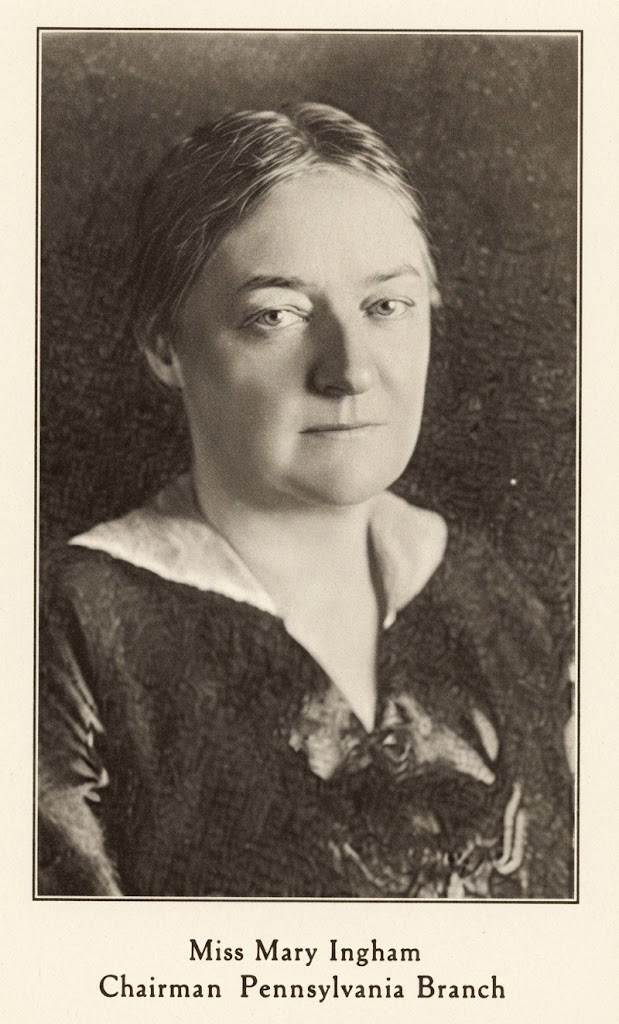 Mary Hall Ingham (November 24, 1866 - January 1, 1937) was born on November 24, 1866, in Philadelphia, Pennsylvania, to Catherine Keppele Hall Ingham and
William Armstrong Ingham. Hailing from a prominent family, her lineage included her grandfather Samuel Delucenna Ingham, who served as Treasury Secretary
under President Andrew Jackson, and her brothers John Hall Ingham and William Ingham. Growing up, she attended the Agnes Irwin School, though she felt
little enthusiasm for traditional society life. Her pursuit of higher education began when she entered the Woman's Medical College of Pennsylvania in
1898, later transferring to Bryn Mawr College, where she earned her Bachelor of Arts degree in 1903. She subsequently pursued graduate courses in
government at Radcliffe College from 1921 to 1923.
Mary Hall Ingham (November 24, 1866 - January 1, 1937) was born on November 24, 1866, in Philadelphia, Pennsylvania, to Catherine Keppele Hall Ingham and
William Armstrong Ingham. Hailing from a prominent family, her lineage included her grandfather Samuel Delucenna Ingham, who served as Treasury Secretary
under President Andrew Jackson, and her brothers John Hall Ingham and William Ingham. Growing up, she attended the Agnes Irwin School, though she felt
little enthusiasm for traditional society life. Her pursuit of higher education began when she entered the Woman's Medical College of Pennsylvania in
1898, later transferring to Bryn Mawr College, where she earned her Bachelor of Arts degree in 1903. She subsequently pursued graduate courses in
government at Radcliffe College from 1921 to 1923.
Following her initial graduation from Bryn Mawr, Ingham worked as a private art history tutor and taught at the Agnes Irwin School from 1905 to 1915.
Simultaneously, she immersed herself in civic reform and leadership, serving as the Philadelphia branch president of the Association of Collegiate
Alumnae from 1906 to 1909. Her reformist efforts extended to labor and municipal governance as she directed the tenement-focused Octavia Hill
Association, served on the Day Nursery Association's board of managers, and directed Philadelphia's Bureau of Municipal Research. A proponent of
progressive politics, she supported the 1910 Philadelphia garment workers' strike, backed Rudolph Blankenburg's 1911 mayoral campaign, and assisted in
forming the Progressive League of Philadelphia while serving as vice chair of the Women of the Washington Party for Theodore Roosevelt's 1912
presidential campaign. She also worked in finance as the head of the women's department for the securities firm William P. Bonbright and Company from
1915 to 1919, and later joined the advisory board and served as vice president of the Women's Trade Union League of Philadelphia, even participating in a
1933 dress factory strike picket line alongside Mrs. Nicholas Roosevelt.
Ingham's most defining legacy lies in her relentless activism for women's suffrage. In 1909, she founded the Equal Franchise Society of Philadelphia,
serving as its secretary. By 1917, she stepped into a national leadership role as chair of the Pennsylvania branch of the National Woman's Party, a
militant suffrage organization founded by Alice Paul. In July 1917, she partook in the Silent Sentinels campaign,
picketing the White House. This action resulted in her arrest alongside 15 other women, leading to a three-day imprisonment in the Occoquan Workhouse out
of a sixty-day sentence. In total, she was arrested three times for her suffrage activism, including an arrest the following year for burning President
Woodrow Wilson's book, The New Freedom, and his effigy. During this tumultuous period of struggle, Ingham shared a queer domestic arrangement with fellow
suffragist Elizabeth McShane, acting as McShane's primary contact, correspondent, and chosen family,
anxiously tracking McShane's harrowing force-feeding experiences while imprisoned and offering steadfast emotional support.
Demonstrating her ongoing commitment to the movement, Ingham joined other previously jailed suffragists in 1919 on a nationwide publicity tour aboard
a railroad car known as the Prison Special, dressed in prison clothing. Following congressional passage, she successfully worked to secure the
ratification of the 19th Amendment by the Pennsylvania legislature on June 24, 1919. In 1920, she picketed the Republican National Convention in Chicago,
pressured President Warren G. Harding to hasten ratification in Republican states, and campaigned for a new state constitution and ballot simplification.
After the adoption of the 19th Amendment, she championed the Equal Rights Amendment and campaigned for the city manager form of government in
Philadelphia.
In her later years, Ingham largely retired from her intense reformist pursuits, though she remained an active mountaineer and supported the League of
Nations. She passed away from cancer on January 1, 1937, at Bryn Mawr Hospital in Bryn Mawr, Pennsylvania, just weeks after entering the hospital on
December 20, 1936, and shortly after celebrating her seventieth birthday. She was laid to rest at West Laurel Hill Cemetery in Bala Cynwyd,
Pennsylvania.
References:
Other references:
- American National Biography Online, Brattain, Michelle. (February 2000). "Ingham, Mary Hall (1866–1937), suffragist and reform activist." Published by Oxford University Press.
- Notable American Women, 1607–1950: A Biographical Dictionary, Disbrow, Donald W. (1971). Edited by Barbara Sicherman. Volume 2 (G–O), Cambridge, Massachusetts: Belknap Press of Harvard University Press, pp. 252–253.
- Library of Congress – National Woman's Party Records, Women of Protest: Photographs from the Records of the National Woman's Party and associated manuscript collections detailing the Silent Sentinels, the Prison Special tour, and correspondence involving Elizabeth McShane.
- Turning Point Suffragist Memorial Foundation, Biographical archive entries detailing Mary H. Ingham's arrests, white house picketing, and suffrage leadership in Pennsylvania.
- The New York Times (Obituary and historical reports covering her 1917–1918 arrests and 1933 trade union picket lines).
- The Suffragist (The official weekly organ of the National Woman's Party, documenting her chairwomanship and activism).
Support this project
This website is a passion project researched, developed, and funded entirely by me. If you find the content valuable and would like to help support the ongoing research and hosting costs, any contribution is deeply appreciated.
Thank you for keeping this independent resource alive!
My books on Amazon: Elisa Rolle's books
BACK TO HOME PAGE
